
Technique lessons
Every sudoku technique, explained.
Eight techniques will get you through almost any puzzle, and each one builds on the last. Every page explains what the technique does, walks through an example, and shows you how to spot it mid-solve.
Light 
Dark


Learn in order
The eight lessons.
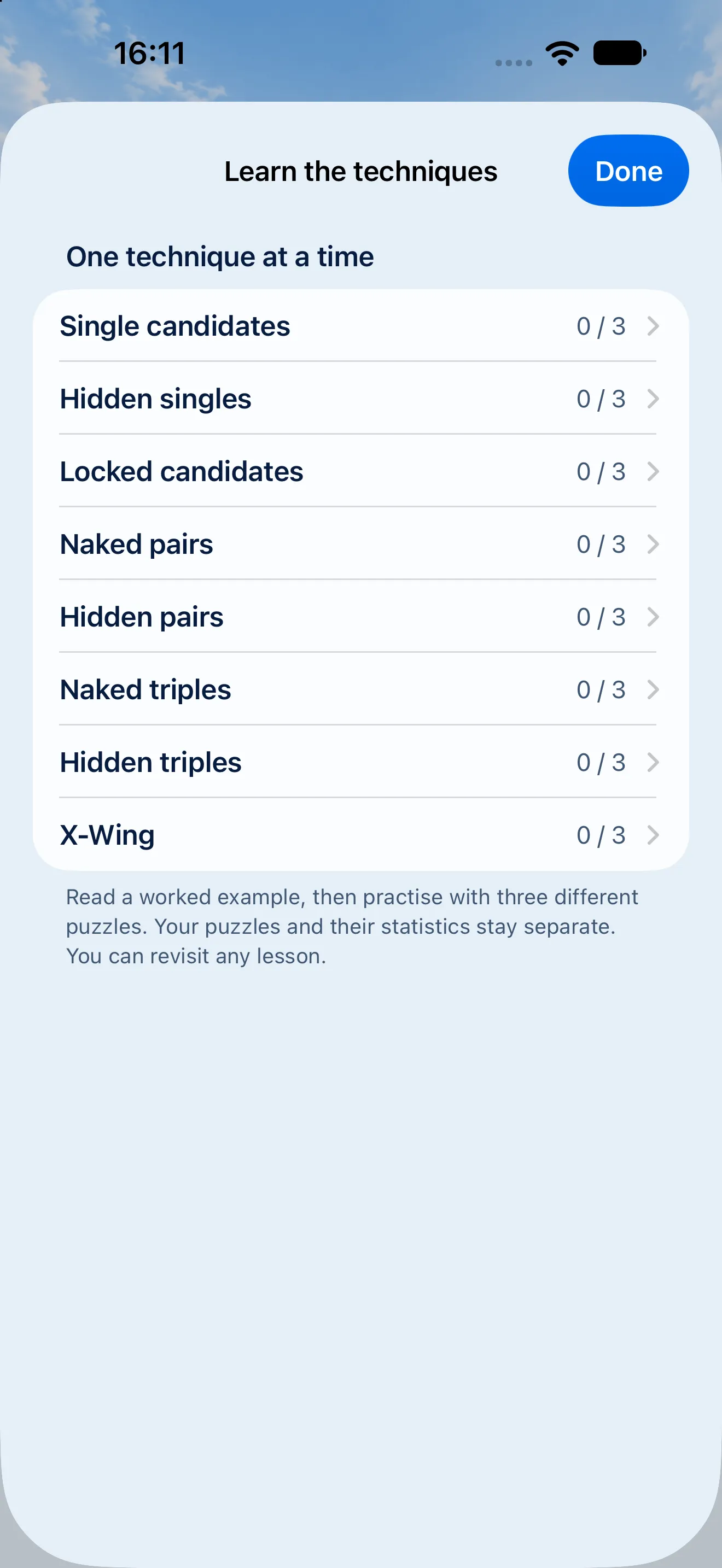
In the same order the game teaches them, from the easiest move to following one digit across the whole grid. Each lesson has a worked example and three practice puzzles.
01
Single candidate
The last digit a cell can take, found by counting what its row, column and box already hold.
Beginner02
Hidden single
A digit that fits in only one cell of a unit, even though that cell can take others too.
Beginner03
Locked candidates
A digit trapped in one line inside a box, or one box inside a line, that can be removed elsewhere.
Intermediate04
Naked pair
Two cells in one unit with the same two candidates, which rules those digits out elsewhere.
Intermediate05
Hidden pair
Two digits that can only go in the same two cells, crowding out everything else in them.
Intermediate06
Naked triple
Three cells in one unit whose candidates together come to exactly three digits.
Advanced07
Hidden triple
Three digits that can only go in the same three cells, clearing the rest of the candidates from them.
Advanced08
X-Wing
A digit with two homes in each of two rows, and both rows sharing the same two columns.
AdvancedFurther reading
Beyond the lessons.
For the really tough puzzles. The game's lessons stop at X-Wing, so these are reference pages: each explains the pattern, works through an example and tells you when it doesn't apply.
Swordfish
Three rows where a digit has two or three homes apiece, all of them inside the same three columns.
Jellyfish
Four rows whose possible cells for one digit all sit inside the same four columns.
Skyscraper
Two rows with two homes each for a digit, sharing one column, which clears the digit from the columns at the other ends.
XY-Wing
A pivot cell with two candidates and two wings, each sharing one candidate with the pivot, which removes a digit from what sees both wings.
Unique Rectangle
Four cells in a rectangle across two boxes that can't all hold the same two digits, because that would give the puzzle two solutions.
XYZ-Wing
A three-candidate pivot with two wings, which removes one digit from the cells that see all three of them.
W-Wing
Two cells with the same two candidates, joined by a strong link on one of them, which removes the other digit from what sees both cells.
Simple colouring
Two-colour a single digit through its strong links, then remove it wherever both colours rule it out.
BUG
A grid where every unsolved cell has two candidates but one, which means the odd cell must take its extra digit.
A solving path
Where to start.
Start with single candidates, then hidden singles, then locked candidates. Each one builds on the last.
New to sudoku?
Read the rules of sudoku, then solve your first puzzle step by step.
Ready for the first lesson?
Single candidates come first: find the only digit a cell can take. Everything else builds on that.
Not sure what comes next?
Pairs and triples clear out pencil marks; X-Wing follows one digit across the grid. The solving guide helps you pick the next move.

One technique at a time.
In Sudoku Mori every lesson comes with a worked example and three practice puzzles. Go back to any of them whenever you like.